
What balsamic vinegar is
The name covers products with different compositions rather than one fixed recipe. Their shared identity comes from grape-derived ingredients and a balance of fruit character and acidity. A bottle may pour like a light table vinegar or be dense enough to coat a spoon. The category’s sensory range clarifies what the name does—and does not—tell you.
Basic definition
Balsamic vinegar is a family of grape-based vinegars used to season food, not a single product made to one universal formula. Grape must—the juice of freshly crushed grapes, often with some pulp and other grape solids—provides the defining raw material. Depending on the product, the must may be used fresh, concentrated, or combined with wine vinegar. These differences affect the balance of fruit sweetness and acidity in the finished vinegar.
The broad culinary name can describe products with different ingredients and production requirements. Some are made under protected specifications, while others are sold as balsamic-style vinegars under broader labeling rules. As a result, products sold under the same general name are not all identical: one bottle may rely on concentrated must for much of its character, while another may contain a larger proportion of wine vinegar. The name alone does not establish a single grape variety, ingredient ratio, or maturation period.
Grape must matters because it contributes more than a sweet taste. Its grape-derived sugars and aromatic compounds give the vinegar a recognizable fruit dimension, while the vinegar component supplies sharpness. The balance depends on the ingredients and their proportions, so two vinegars can share a grape base yet taste noticeably different. Reading the ingredient list gives you a more specific picture than relying on the broad category name.
In everyday cooking, the term identifies a versatile grape vinegar rather than a guaranteed flavor, thickness, or recipe. A precise product description may name its origin or production standard, but the general term does not promise that every bottle follows that same standard. The term refers to a family of related vinegars, which explains why bottles vary in both composition and character.
Flavor and texture
The characteristic flavor balances sweetness with acidity. Grape notes can suggest ripe fruit, dried fruit, or cooked fruit, while the vinegar contributes a clean, tart edge. The result is usually more rounded than a plain, sharply acidic wine vinegar, but sweetness and intensity vary considerably between bottles. A product with more concentrated grape must may taste fruitier and sweeter; a formulation with more wine vinegar can come across as sharper and less dense.
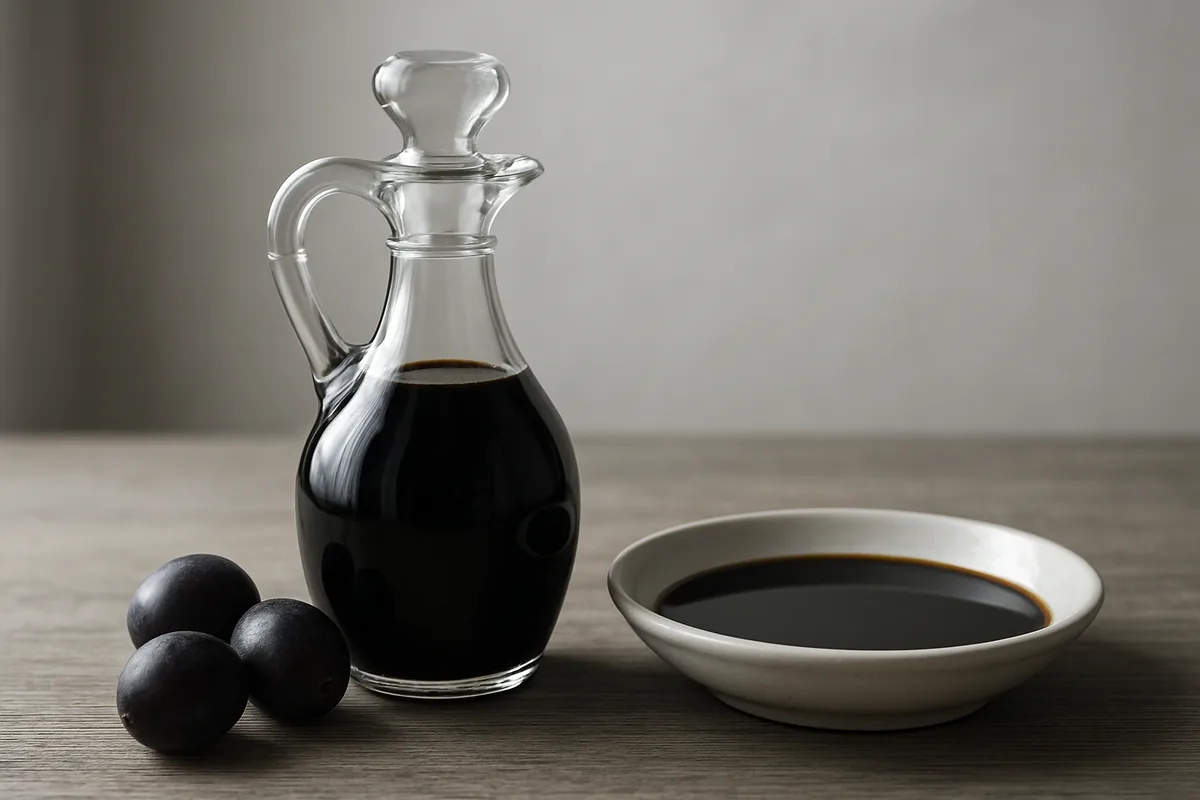
Texture ranges from thin and freely pourable to thick and syrupy. A lighter vinegar runs quickly from a spoon and spreads easily across a dish; a concentrated one clings to the spoon and leaves a slow-moving trail. That difference is not a reliable measure of quality on its own. Ingredient proportions and the degree of concentration both affect viscosity, so a thick texture does not automatically mean a product has been aged longer.
Maturation can also change the sensory profile. With time in wood, a vinegar may become more integrated, with softer acidity and more developed aromas; evaporation can contribute to greater concentration. The type of formulation still matters: a younger vinegar built around concentrated must may be sweet and full-bodied, while a more mature one can show layered aromas without tasting simply sugary. Aging influences the result, but it is not the only factor that determines it.
When you assess a bottle, consider sweetness, acidity, aroma, and flow together rather than judging by color or thickness alone. A balanced vinegar has enough acidity to keep its grape sweetness from tasting cloying, while its texture should suit the character you expect from that product. These sensory differences explain why the broad name covers both bright, pourable vinegars and dense, richly flavored ones.
How balsamic vinegar is made
The production method depends on the kind of balsamic vinegar being made. Traditional production begins with grape must that is cooked before fermentation, then develops through acetification and prolonged aging. Other balsamic-style products can combine different grape ingredients and vinegar bases, with methods and maturation times that vary by producer. Following these stages shows why the same broad name can describe vinegars made in quite different ways.
Grape must
Grape must is the freshly pressed juice of grapes together with the solid parts carried through pressing: skins, seeds and, depending on how the grapes are handled, stems. Unlike clarified grape juice, it contains material that can contribute compounds during processing. Its natural sugars provide the substrate for fermentation, while the solids are separated or settle as production proceeds.
For traditional balsamic vinegar, producers cook the must before fermentation. Heating drives off water and concentrates the sugars and other grape components, producing a dense base. The cooking is controlled rather than treated as a fixed recipe: the grape variety, ripeness, vessel and degree of concentration all affect the resulting must. It is not simply finished vinegar with sugar added; the cooked must is the starting material for subsequent fermentation and aging.
Other balsamic-style vinegars may use a different combination of ingredients or preparation. A producer might use cooked or concentrated must, grape juice concentrate, wine vinegar, or a blend of these, and the base need not undergo the same cooking step as traditional production. Some products also rely on a separately made vinegar as their acidic component. For that reason, grape must describes an ingredient, not a single method shared by every product called balsamic vinegar.
The practical distinction is the must’s role: in traditional production, cooked grape must is the central raw material, while in other products it may be blended with vinegar or processed in another way. Reading the ingredient list can indicate whether a vinegar is based mainly on cooked must or uses a vinegar-and-grape mixture.
Fermentation and aging
After cooking, the sugars in traditional must are converted first by yeasts into alcohol. Acetic acid bacteria then convert some of that alcohol into acetic acid, the principal acid in vinegar. These biological stages are often described as fermentation and acetification; in practice, they can overlap as the must develops. The sequence depends on natural microbial activity and the conditions in the vessel, rather than on simply mixing acid into the cooked must.
Traditional balsamic vinegar then matures slowly in wooden barrels. Producers commonly use a battery of casks made from woods such as oak, chestnut, cherry or mulberry, with barrel sizes and arrangements varying. As water evaporates through the wood, the liquid gradually concentrates. During periodic transfers, a portion moves from a larger cask into a smaller one, while the larger barrel is replenished with younger material. This gradual topping-up and movement allows successive batches to develop together instead of treating each barrel as an isolated, sealed lot.
The aging period is measured in years for traditional balsamic vinegar, not weeks. Traditional Balsamic Vinegar of Modena is aged for at least 12 years, and its extra-old designation requires at least 25 years. The long maturation combines slow concentration with continuing changes in the barrel, so the finished product reflects both its cooked-must base and its time in wood.
Other balsamic-style vinegars do not follow one uniform timetable. Some use wine vinegar blended with cooked or concentrated must, and producers may ferment components separately before blending them. Aging can be brief, carried out in a different vessel, or omitted; some products may also mature in wood for a longer period. These alternatives can be made for different costs and uses, but they are not made or aged in the same way as traditional balsamic vinegar.
Styles and labeling
Balsamic products range from two traditional protected styles to products made under other designations or sold under broader descriptions. Their names on the label indicate different rules for origin, ingredients, production and aging. A protected designation sets requirements for the product that carries it; the word “balsamic” alone does not establish one shared recipe or method. Comparing the precise name and ingredient list is the clearest way to tell these styles apart.
Traditional styles
Traditional Balsamic Vinegar of Modena PDO and Traditional Balsamic Vinegar of Reggio Emilia PDO are two distinct protected traditional styles from Emilia-Romagna, Italy. Their European Union Protected Designation of Origin status links each product to its defined area: the grapes and production must meet the relevant specification for Modena or Reggio Emilia. The designations therefore identify more than a place name or a flavor description.
Both styles are made exclusively from cooked grape must, rather than a blend of grape must and wine vinegar. The PDO specifications govern the permitted grapes, processing, and the steps carried out in the designated area. They also require aging in wooden casks for at least 12 years. Products aged for at least 25 years may use the additional description “extra old,” subject to the applicable rules.
Check the full protected name on the front label: “Traditional Balsamic Vinegar of Modena” or “Traditional Balsamic Vinegar of Reggio Emilia.” The PDO mark is another indication that the product is certified to the corresponding specification. A bottle labeled only with a general balsamic description does not, by that wording alone, qualify for either traditional designation. These names make origin and production rules visible at the point of purchase, while the stated age category distinguishes the required minimum aging from the extra-old classification.
Other balsamic-style vinegars
Outside the two traditional PDO styles, products sold as balsamic vinegar can follow different specifications. A prominent protected alternative is Balsamic Vinegar of Modena PGI, which has its own defined recipe and production rules; other products may be governed by different market rules or sold under broader descriptions. The table compares these categories without assuming that every bottle bearing a balsamic label is made alike.
| Product category | Composition | Production and aging | Label and typical character |
|---|---|---|---|
| Traditional Balsamic Vinegar of Modena PDO or Reggio Emilia PDO | Cooked grape must only. | Made under the relevant PDO specification; aged in wooden casks for at least 12 years. “Extra old” requires at least 25 years. | The full traditional name and PDO designation identify the protected style. Typically concentrated and used sparingly. |
| Balsamic Vinegar of Modena PGI | At least 20% cooked or concentrated grape must and at least 10% wine vinegar; caramel coloring is permitted up to 2%. | The PGI specification requires maturation in wooden vessels for at least 60 days. The “aged” indication requires at least 3 years. | The protected name is “Balsamic Vinegar of Modena,” with the PGI designation. Its character varies with the blend and aging. |
| Other balsamic-style products | Recipes vary; labels may list grape must, concentrated must, wine vinegar, or other permitted ingredients. | Methods and aging periods depend on the product and applicable rules; there is no single aging minimum for this broad category. | Read the product name and ingredient list. Flavor and texture vary, from sharper vinegar-led styles to sweeter blends. |
For the PGI product, the “aged” wording has a defined minimum, while the unqualified category does not carry one universal aging period. For other bottles, the ingredient list and any stated designation give more useful detail than the word “balsamic” on its own.
Using balsamic vinegar
Balsamic vinegar can season a vinaigrette, add depth to a marinade, or build a quick pan sauce. Its sweet-tart character can balance rich, earthy, or browned ingredients, but the right amount depends on the dish. Start with a small measure and taste after it is mixed or cooked with other ingredients. For how to use balsamic vinegar at the table, a few drops added just before serving can sharpen a dish without overwhelming it.
Dressings and marinades
For a dressing, marinade, or cooked sauce, account for the vinegar’s acidity and sweetness alongside the other ingredients. Dilution and timing help keep its flavor balanced.
- Whisk one part balsamic vinegar with three parts olive oil for a balanced starting point; add salt gradually, since feta or olives contribute salt.
- For chicken or pork, mix vinegar with oil, garlic, and a pinch of salt; add a little honey only when the dish needs extra sweetness.
- For thin cuts, start with 30 minutes of marinating; thicker pork chops can take up to four hours, as prolonged acidic contact can soften the surface.
- After searing meat, deglaze the hot pan with a splash of vinegar and stock, scraping up browned bits, then simmer until lightly thickened.
- Stir vinegar into tomato or mushroom sauces during the final five minutes of cooking; taste before adding salt, since simmering concentrates the sauce.
- For a reduction, simmer vinegar gently in a small pan for about five to ten minutes, stirring often; add a spoonful of water if it thickens too quickly.
A salad dressing with balsamic vinegar can be loosened with more oil or a teaspoon of water if it tastes too sharp. For cooked sauces, add the vinegar late when a fresher tang is wanted, or simmer it longer for a rounder, more concentrated result.
Finishing and pairings
A small finishing addition can sharpen a dish or balance its richness, especially when applied after cooking. Treat pairings as starting points: adjust the amount to the food’s sweetness, salt, and texture.
- Over roasted carrots, squash, or Brussels sprouts, use about one teaspoon per two servings after cooking; the small dose counters browned sweetness without making them sour.
- With sliced strawberries or grilled peaches, add a few drops just before serving; taste first, since ripe fruit may need only a little acidity.
- Drizzle lightly over aged cheddar or a firm, salty cheese, where a modest sweet-tart accent can offset richness; serve extra separately for individual preference.
- For roast pork or grilled steak, add a small splash after resting and slicing, rather than during searing, to preserve a distinct finishing note.
- Toss warm farro or barley with a teaspoon of vinegar per cup, then adjust with olive oil and salt; the grains should taste seasoned, not sour.
Begin with a few drops, mix or taste, and add more only if the dish still needs contrast. The same amount can read differently on sweet fruit than on salty cheese or savory grains.
Balsamic vinegar and balsamic glaze
Balsamic vinegar and balsamic glaze can share a base, but they behave differently on food. The vinegar is usually fluid enough to mix into other ingredients, while glaze is thicker and stays where it is drizzled. Their sweetness and acidity can also differ, especially when a glaze contains added sweeteners or thickeners. Comparing texture, ingredients, and intended use makes it easier to choose the right one for a dish.
Texture and composition
Pourable balsamic vinegar is a fluid condiment; glaze is concentrated or thickened to make a slower-moving, syrup-like finish. Glaze is not simply another name for every balsamic vinegar: its texture and, often, its ingredient list set it apart.
| Feature | Pourable balsamic vinegar | Balsamic glaze |
|---|---|---|
| Texture | Thin and readily pourable; it spreads quickly over a plate. | Thick and syrup-like; it clings to food and can form a defined line. |
| Typical composition | Balsamic vinegar, with ingredients varying by product; check the label for the specific formulation. | Often reduced balsamic vinegar; packaged versions may also contain sugar or another sweetener, and sometimes a thickener. |
| Flow | Runs in a continuous stream and mixes readily with oil or other liquid ingredients. | Moves slowly from a squeeze bottle or spoon and is less suited to blending evenly into a thin mixture. |
| Sweetness and acidity | Usually has a more noticeable tang, balanced by its own sweetness; the balance varies by product. | Often tastes sweeter, which can soften the impression of acidity, though the actual balance depends on its ingredients and concentration. |
| Common function | Useful as a liquid component in dressings, marinades, and sauces. | Used mainly as a finishing drizzle when a thicker coating and visible lines are wanted. |
The label matters because products sold as glaze do not all use the same recipe: some rely on reduction, while others add ingredients to create body and sweetness. A balsamic glaze and reduction can therefore differ in both texture and ingredient composition.
Choosing for a recipe
Choose pourable balsamic vinegar when the recipe needs a liquid that can disperse through other ingredients. It blends more easily into a salad dressing with oil, mustard, or herbs, and its acidity can help balance the richness of a marinade or pan sauce. Because products vary in sweetness and sharpness, taste the mixture before adding extra sweetener or acid.
Choose glaze when the goal is a concentrated, visible finish rather than an ingredient that disappears into a mixture. Its thicker consistency is suited to drizzling over cooked vegetables, meat, or fruit just before serving; a small amount can add both sweetness and a glossy coating. Read the ingredient list if sweetness needs to stay controlled, since some glazes contain added sugar or thickeners.
Substituting one for the other changes more than texture. Replacing vinegar with glaze can make a dressing or marinade sweeter and thicker, while using vinegar instead of glaze produces a thinner result with a more apparent tang and less defined drizzle. If a recipe calls for glaze but only vinegar is available, reduce a small amount gently until it coats a spoon, then taste it; for a dressing or marinade calling for vinegar, use a pourable product rather than trying to thin glaze, which may retain added sweetness and thickness.